

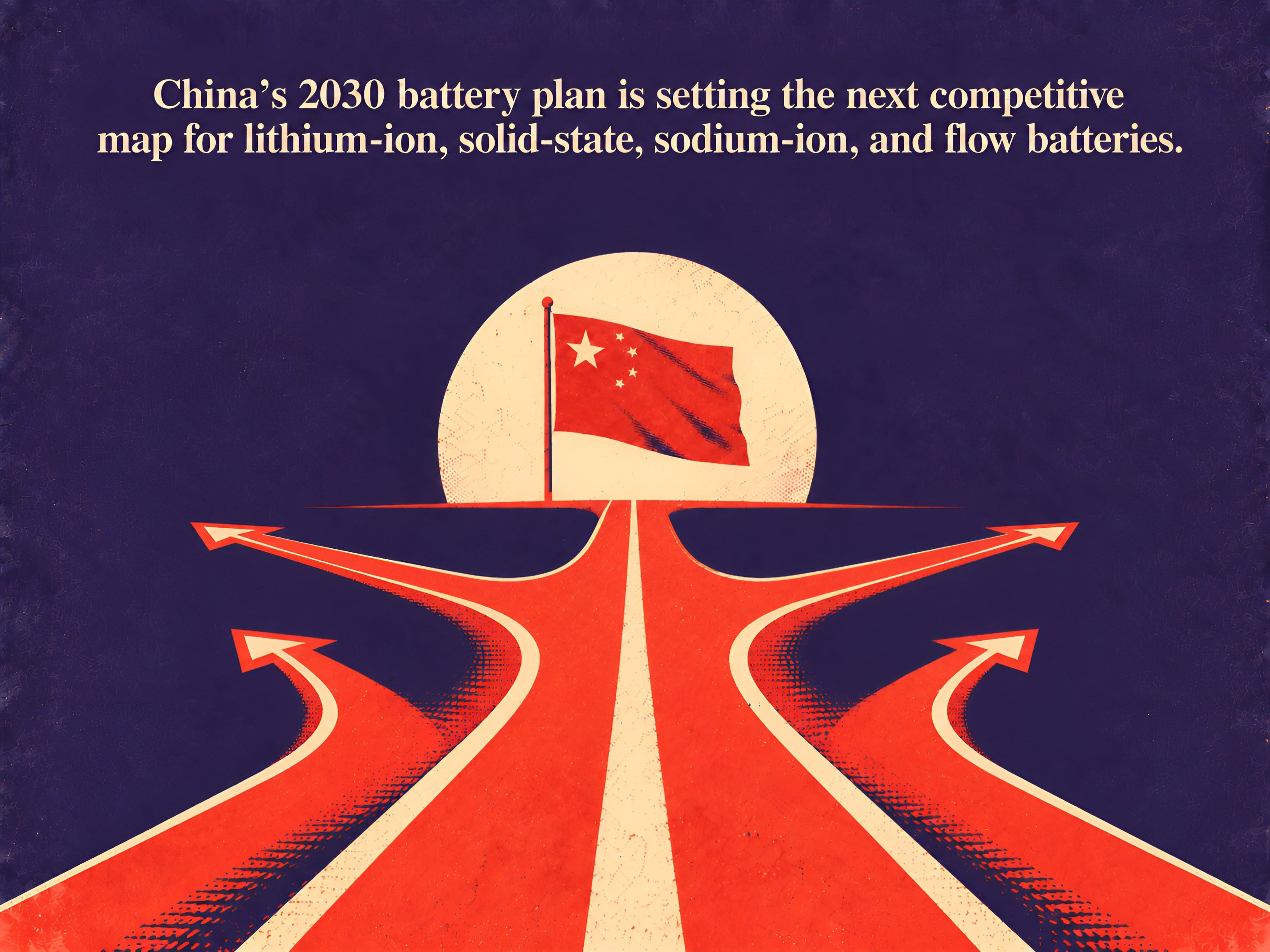
China just laid out its battery roadmap through 2030.
Its new 15th Five-Year Plan (2026-2030) for the battery industry sets targets for all-solid-state, sodium-ion, flow, and lithium-ion technologies. As China dominates the market, these priorities will impact the entire supply chain, from raw material suppliers to global buyers.
By identifying priority applications for different battery technologies, Beijing is showing where competition will hit over the next five years.
Here’s the plan for each technology and what it means for battery suppliers and buyers.
A 15,000-cycle target raises the competitive bar
China wants long-life lithium-ion batteries to reach 15,000 cycles by 2030.
Though the plan doesn’t state it explicitly, that target is meant specifically for LFP batteries.
In its review of the previous five-year plan, covering 2021–2025, battery cycle life had already exceeded 12,000 cycles at the upper end of the range.
Chinese manufacturers have reported even 15,000 cycles or more for products including Ampace’s Kunlun LFP cells, HiTHIUM’s MIC1130Ah cells and CATL’s energy-storage batteries.
For grid developers, more cycles can mean more electricity delivered before a battery needs replacement. But batteries also age over time, so the benefit depends on how they are used.
To support this target, the Ministry of Industry and Information Technology (MIIT) is calling for better electrode materials, electrolytes, equipment, and system integration. It also wants stronger standards, testing, and certification.
Suppliers developing sodium-ion or flow batteries have to compete with lithium-ion batteries that will keep improving.
Comparing their technologies with today’s lithium-ion performance risks overstating their advantage.
CATL and BYD’s 2027 schedules make China’s 2030 solid-state target plausible
China aims to begin deploying all-solid-state batteries at scale by 2030.
The plan identifies applications ranging from electric vehicles to low-altitude aircraft and intelligent robots, but does not specify which will drive all-solid-state battery deployment.
The Ministry of Industry and Information Technology identifies the materials and manufacturing processes that need further development. For electrolytes, it supports sulfide, halide and polymer-composite routes, calling for better ionic conductivity and greater mass-production capability.
Supporting several chemistries gives suppliers room to compete with different technical solutions. At CIBF in China, I saw this firsthand: materials suppliers were already offering these different electrolyte options to the market.
MIIT calls for better contact between cell materials, longer cycle life, and better pressure-system design. It supports the development of manufacturing equipment, including isostatic presses.
These priorities reflect the work needed to move from trial cells to reliable production, involving both battery manufacturers and their suppliers.
The leading companies’ schedules broadly match the policy. (That’s not a coincidence.)
In July 2026, CATL reiterated its timeline for small-batch production of all-solid-state cells in 2027. That same year, BYD expects sulfide solid-state cells to reach small-batch runs, with Executive Vice President Stella Li confirming a 2027 vehicle model using solid-state tech.
If those schedules hold, manufacturers would have roughly 3 years to expand production toward the plan’s 2030 industry objective.
That makes initial deployment at scale by 2030 plausible.
But the public plan provides no GWh volume or market-share target, so it remains unclear what the industry penetration rate will be.
China sets priority uses for sodium-ion and flow batteries but leaves sodium-ion performance targets open
While lithium-ion remains the core focus, China’s 15th Five-Year Plan gives sodium-ion and flow batteries specific roles, with each serving different needs.
For sodium-ion, MIIT prioritizes three specific use cases: high-power start-stop batteries, cold-resistant traction packs, and long-life energy storage. They call for higher-capacity cathodes and more densely compacted anodes to improve performance.
The published plan sets no explicit Wh/kg energy density, operating temperature, or cycle-life targets for sodium-ion. That leaves the numerical benchmark open to market competition.
For flow batteries, the priorities are long-duration and household storage. MIIT calls for higher stack current density, better energy-conversion efficiency, and lower electrolyte costs. It supports all-vanadium systems and improvements in the power density and cycle life of iron-based, zinc-based, and organic flow batteries.
For foreign players, these priorities indicate where China wants the battery industry to head.
The plan calls for funding support and technical improvements across several battery technologies, leaving companies to turn them into commercial products rather than prescribing which products should win.
But conventional lithium-ion will keep improving.
Its progress will set the minimum these alternatives, including solid-state batteries, have to compete against. Over the next five years, customer adoption will show where each finds a market.
P.S. When the time is right, there are other ways I can support you:
Become a paid subscriber
Get access to the Monthly Briefing and deeper research on the battery industry. I do the digging, so you spend less time following the market and more time using the information.
You can upgrade here: Paid tier
Battery market reports
I’ve published 2 reports so far: The Battery Starter Kit, to help you get up to speed on the battery industry, and the CATL Company Profile, to help you understand how CATL operates and why it leads the market.
You can find them here: Battery industry reports