


The industry conversation about Tesla still circles around vehicle sales, FSD timelines, and Elon Musk’s social media posts.
Almost nobody is paying attention to what Tesla is doing with lithium.
Or cathodes. Or LFP cells. Or dry electrode manufacturing.
While the press argues about quarterly deliveries, Tesla has assembled the most complete battery vertical integration strategy of any Western automaker.
Four separate facilities. Multiple chemistries. Processed raw material to finished cell.
The assets that will determine cost competitiveness over the next decade are being built right now. And most of the industry is looking somewhere else.
The four pillars
Tesla’s 4680 cell manufacturing at Giga Texas has been running since 2022. The company produced its 100 millionth cell by September 2024.
By the end of that year, Tesla’s in-house 4680 had become its lowest-cost cell per kWh, beating suppliers including Panasonic and LG Energy Solution. (Source: Michael Guilfoy, Tesla Director of Cell Manufacturing, LinkedIn)
During the Q4 2025 earnings call on January 28, 2026, Tesla confirmed two things.
First, it had started building Model Y battery packs with 4680 cells again, as Cybertruck sales are lower than expected.
Second, it now produces both the anode and cathode for the 4680 using its dry electrode process.
That process came from the Maxwell Technologies acquisition in 2019 and took five years to scale. It cuts energy use and factory floor space compared to conventional wet coating.
CFO Vaibhav Taneja called batteries Tesla’s “biggest constraint globally.” The company’s response is to build more of its own.
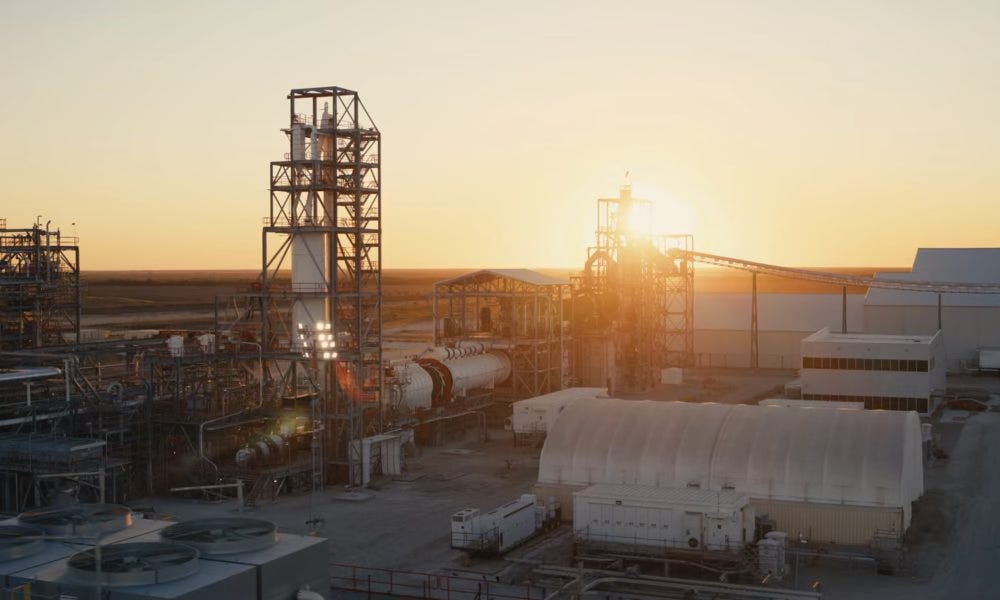
The lithium refinery in Robstown, Texas, near Corpus Christi, broke ground in May 2023. By January 2026 it was operational.
It is the first spodumene-to-lithium-hydroxide refinery in North America. Tesla uses an acid-free refining route that skips intermediate steps normally routed through China.
The facility targets 30 GWh of annual lithium refining capacity and is in early ramp. The project went from dirt to production in under three years.
At Giga Texas, Tesla filed for a $716 million expansion in January 2023 that included cathode manufacturing capabilities among multiple projects totaling approximately 1.5 million square feet.
Cathodes are the most expensive single component in a battery cell, accounting for more than 35% of total cell cost.
The cathode facility is already in production (early ramp), and its capacity is about 10 GWh.
The fourth piece is an LFP cell factory at Gigafactory Nevada in Sparks. Tesla acquired idle manufacturing equipment from CATL and is building a facility with roughly 7 GWh of initial annual capacity.
As of June 2025, the factory was nearing completion, with production slated for early 2026.
That is now underway, with early ramp-up production in progress.
These prismatic LFP cells will primarily supply Tesla’s energy storage products, which are now the company’s fastest-growing business line.
The energy storage math
The Q4 2025 results explain why Tesla needs that LFP factory so badly.
Tesla deployed 46.7 GWh of energy storage in 2025, up 49% from 31.4 GWh in 2024. The energy division generated $12.77 billion in revenue for the year, up 26.6%. Q4 energy gross margin hit 28.7%, with gross profit reaching a record $1.1 billion.
Energy now runs at nearly double the profit margin of Tesla’s vehicle business.
Buying all those cells from external suppliers gets expensive at 46.7 GWh per year.
Producing LFP cells domestically also reopens the option of LFP-based vehicles in North America, where tariffs on Chinese-made cells had blocked standard-range models.
The company has committed over $20 billion in capital expenditure for 2026, with a significant share directed toward energy storage, cell production, and the lithium refinery.
Why batteries are different from brake pads
The auto industry spent three decades moving away from vertical integration.
GM divested Delphi in 1999. Ford spun off Visteon in 2000.
The consensus since the mid-1990s has been clear: specialize, outsource, manage suppliers. Cost efficiency comes from letting specialists compete for your business.
Tesla is going against that orthodoxy. A sophisticated reader should immediately ask: Why is this different?
Three reasons.
First, batteries are the single largest cost component in an EV, accounting for 30-40% of the total vehicle cost. No other component comes close. The financial exposure is too large to leave entirely to suppliers.
Second, battery chemistry and manufacturing processes are still evolving fast. Dry electrode, silicon anode, LFP, sodium-ion. Companies that make cells learn things that companies that buy cells do not.
Third, the supply base is concentrated in a geopolitical rival. China controls roughly 80% of global battery material refining. Depending on that supply chain while tariff policy shifts every quarter is a structural vulnerability.
Brake pads are a commodity with dozens of interchangeable suppliers. Battery cells are not.
That distinction is what makes Tesla’s bet rational, even if it contradicts 30 years of automotive supply chain orthodoxy.
The real benchmark is BYD, not GM
Comparing Tesla to Western OEMs who are retreating is easy.
GM sold its stake in a planned battery plant to LG Energy Solution. Same for Stellantis. Ford dismantled its JV with SK On in the U.S.
The Western OEM retreat is well documented.
But the comparison that tests the thesis is BYD.
BYD manufactures roughly 75% of its vehicle components in-house. That includes cells, cathode material, electric motors, power electronics, and semiconductors through BYD Semiconductor.
BYD holds lithium mining stakes in Brazil, Africa, and China.
Tesla’s vertical integration is the most ambitious in the West. Measured against BYD, it is still incomplete. Tesla has no semiconductor operation. No mining equity.
Its LFP factory runs on acquired CATL equipment, not proprietary technology. Its lithium refinery is in early ramp while BYD has been refining at scale for years.
The honest framing is this: Tesla is the only Western company even attempting to match the Chinese model of full-chain ownership.
The gap between Tesla and BYD is still large. The gap between Tesla and every other Western OEM is growing.
The fixed-cost trap
Vertical integration carries a structural downside that this industry learned the hard way.
When demand drops, vertically integrated companies absorb all the fixed costs. Outsourcers can flex volume down. GM divested Delphi precisely because owning its supplier base became a liability in downturns.
The logic that drove the outsourcing wave of the 1990s was a response to cyclicality.
Tesla vehicle deliveries declined in 2025. The company delivered 1.636 million vehicles, down year-over-year. It discontinued Model S and Model X. The Cybertruck, the primary 4680 vehicle, sold below production capacity.
Tesla now has a lithium refinery, a cathode plant, a 4680 line, and an LFP factory all running or ramping while vehicle volumes fell.
That is a lot of fixed cost to carry.
The energy storage business absorbs some of that cell production. But if both vehicle and storage demand soften in the same quarter, every one of those facilities becomes a financial drag.
What this comes down to
Tesla’s vertical integration is a bet on two things: that trade barriers persist, and that demand keeps growing.
If US tariffs on Chinese batteries and materials stay high, Tesla’s domestic supply chain becomes a structural moat.
Average battery pack prices in North America run 44% higher than in China (Source: BloombergNEF, 2025). In-house production behind tariff walls turns that gap into margin.
If tariffs soften or get renegotiated, Asian cell makers flood the market at lower cost and Tesla’s fixed investments look very different.
The 4680 program took five years of painful iteration. Musk reportedly set the KPI in May 2024: if 4680 costs could not beat LG and Panasonic by year-end, the in-house program would be reconsidered.
They met that target. But meeting a cost target inside a tariff wall and meeting it in an open global market are two different achievements.
Tesla has built something no other Western automaker has. The question is how much of its value depends on the wall staying up.
If you find this kind of analysis useful, you may also be interested in two standalone resources I’ve built alongside the newsletter.
I don't know why GM is even brought up. From Western manufacturers the only one that can surpass Tesla is VW. VW have their own battery tech (PowerCo subsidiary of VW) and 20 GWh gigafactory in Germany with capability to 40 GWh, plus the second 40 GWh factory being built in Spain currently (completed in 2027) with ability to expand to 60 GWh in phase 2. There is 3rd plant in Canada with phase 1 being 90 GWh, but to be seen will that be fully constructed.
VW Groups MEB+ cars will no doubt heavily increase their volumes in 2026 compared to the 1 million EV's sold in 2025.
VW Group is not that heavily invested on lithium mines yet. They own 10% of Patriot Battery Metals in Canada.
The elephant in the room is anode supply ex-China. The supply chaini is as only strong as the weakest link and that looks to be anodes.
Tesla looks to be relying on imports by BTR etc and the latest export control drew attention to the fact....no anode no battery. Musk has said publicly we are leaving anodes to someone else...hope he's not relying on import alone.